Wednesday, October 19, 2016

GERMAN LEGION: MONOCHROME WARRIORS OF THE HUNGARIAN REVOLT


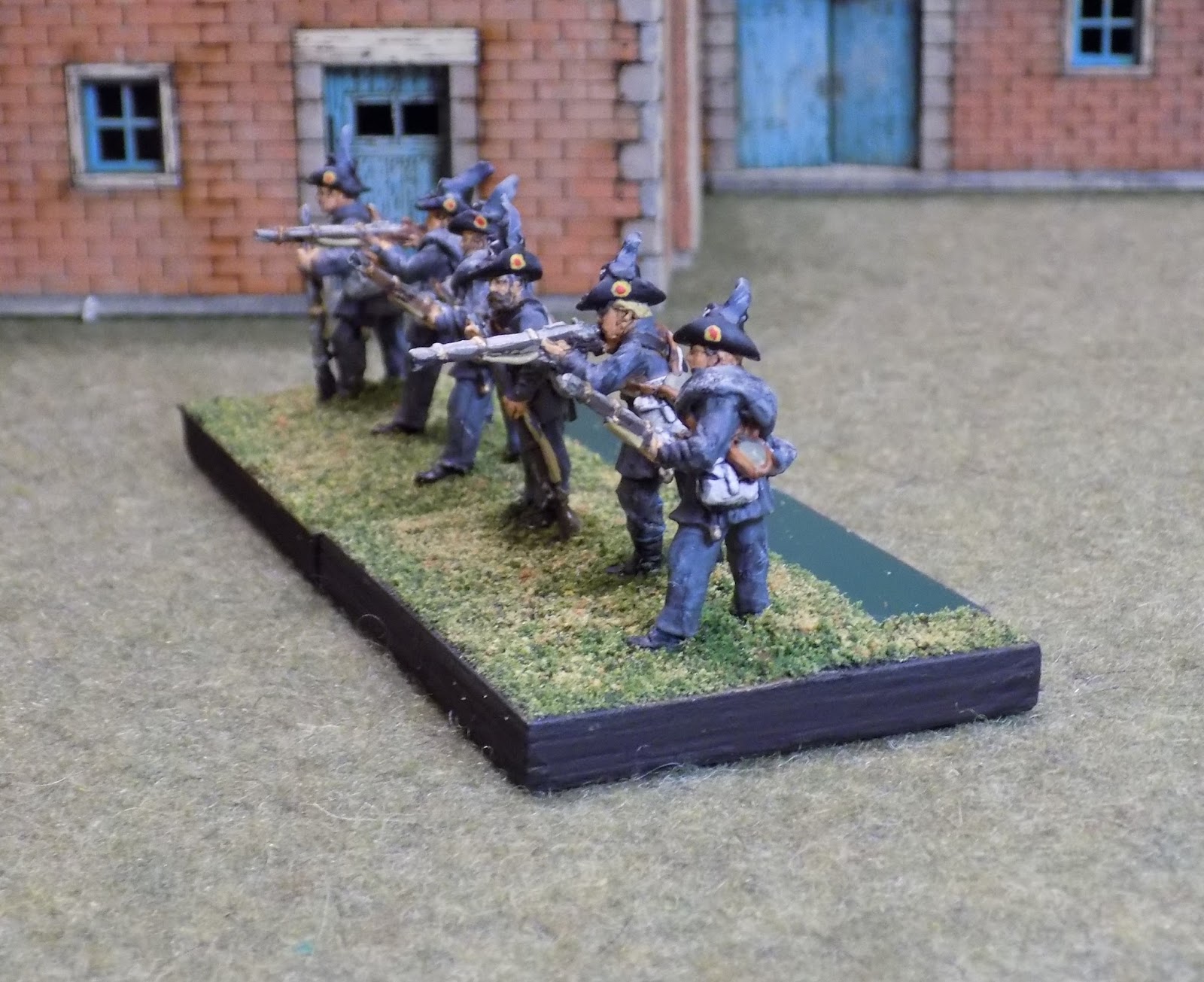
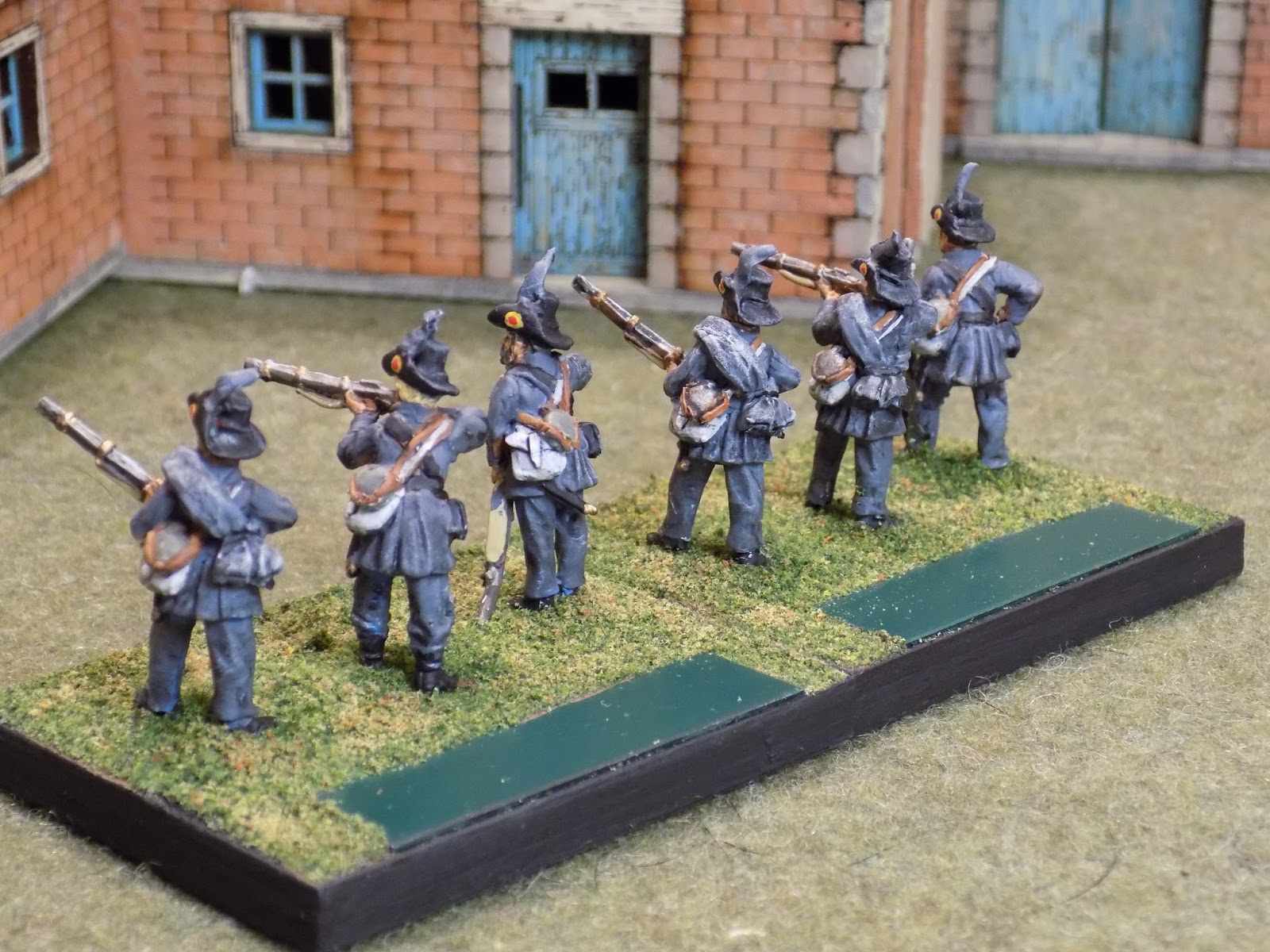
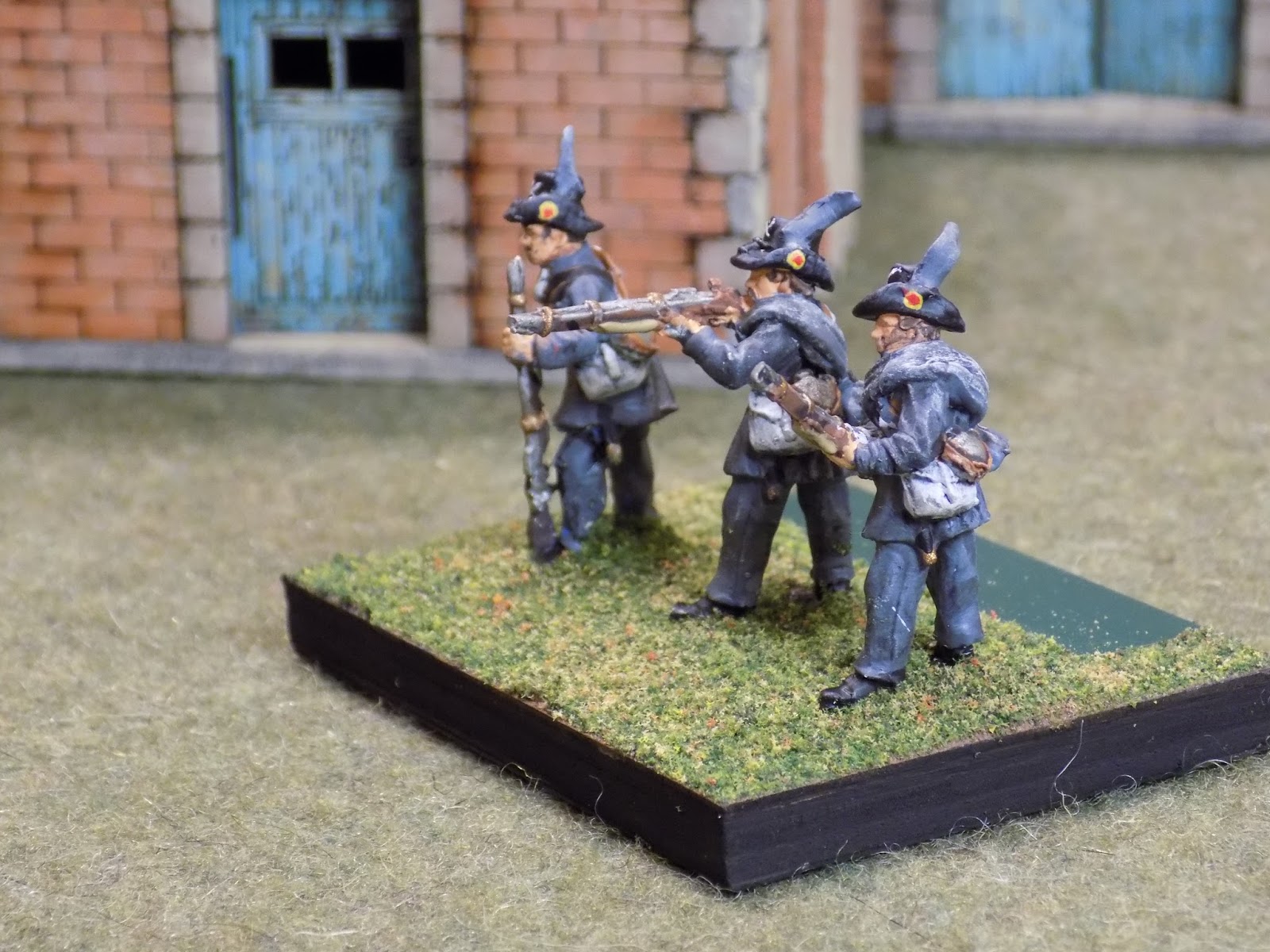
Another new addition: this time it's the German Legion of the Hungarian Revolution, an exercise in gray tones. These fellows were not uncharacteristic of any number of volunteers of the era. Earlier, I created a more colorful set of general purpose German volunteers, inspired by a similar volunteer uniform from the Schlewsig Holstein affair. In this case, I wanted to adhere to an actual documented historical uniform. Depending on the source, the color of the German Legion's uniform runs from more black to more gray (I believe that the sharpshooter company of this unit was actually in black). I went with dark gray uniforms and black hats. As usual, clix pix for BIG PIX... 

Here is an illustration of the unit from the excellent The Hungarian Army 1848-1849 by Ralph Weaver (Partisan Press, distributed by Caliver Books).


To represent the unit, I went with the Perry ACW Iron Brigade figures:

I turned up the hat brims on the few that didn't already have them turned up and I fabricated a feather out of lead foil, reinforced by liquid weld. I drybrushed the black hat with a bit of gray to give it texture.  I went with the gray feather as in the illustration. The results:


The cap badge wound up being a bit more impressionistic than I had hoped (the gap between what we aim for vs what we achieve being apparent), but at gaming distance it evokes the death's head better than in pictures. The shading strokes are a bit more abrupt in the photographs than with the naked eye. Another one of those effects that doesn't draw attention to itself (I hope).  Not the most colorful unit, but a distinctive one--and what black powder era gaming table isn't spruced up by a unit of Germans in dark garb wearing a totenkopf badge? I can see these fellows being referred to as the "black hats" in play.

Sunday, October 16, 2016

CLUB GAME DAY: FRENCH AND INDIAN WAR

This Saturday our gaming club had one of its game days. The man behind the effort was Earl, who orchestrated a day consisting of two rounds of three Bloody Tomahawks games running simultaneously. Players were divided into French and British teams, and each scenario was based on a historical event. Each game contributed to the side's overall victory points, although nobody seemed overly concerned about that (aside from Early, who had to keep track!). I can't do better than to quote our club president's email to summarize:

"Earl put on a great game day. The tables and figures looked great and the scenarios were fun to play. Knowing how much work it is to put on a game day, I want to thank Earl on behalf of the club. I am sure that he is relieved it went well, happy it is over, and completely bushed...once again thank you and great job. By the way, does anyone want a donut?"
The man of the hour: Earl at his command post.

The expedition was well provisioned.
Here are some images of the day. Clix Pix for BIG PIX. 

Earl was everywhere!  How did he DO that?

Friday, October 14, 2016

SOMEWHERE IN SAXONY, 1813: NAPOLEONICS AGAIN!

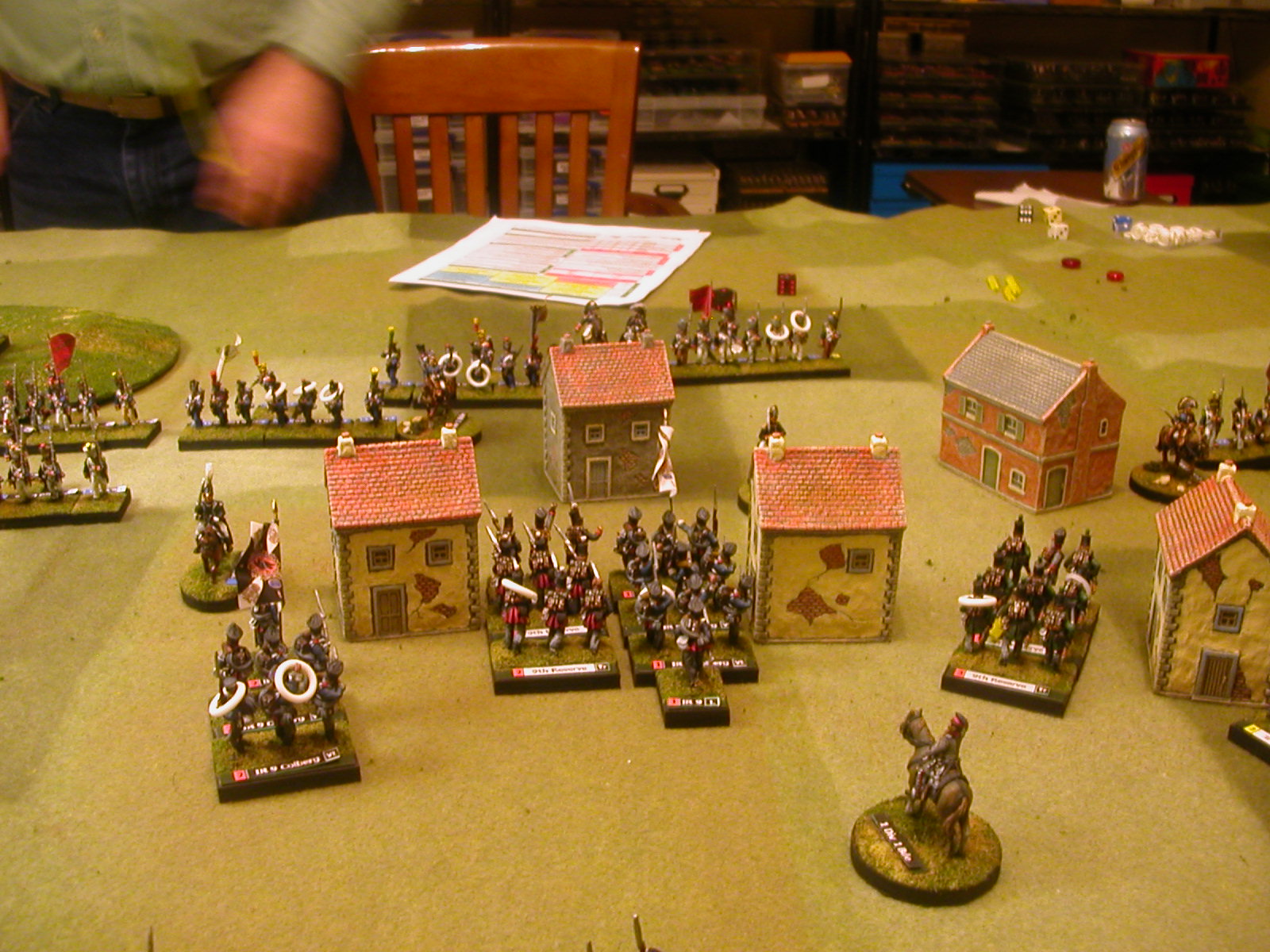
Thursday evening, Charlie came over to my place for a quick Napoleonic game to get the Prussians on the table for the first time in his Napoleon's Rules of War rules (a system that Charlie has been working on with our group for the last several years, soon to be published). The main aim of the evening was to run a bunch of turns and to see if there were any glaring issues with the structure of the Prussian army list or unit characteristics. We came up with a few adjustments, but overall, there were no hang-ups. I was happy for the chance to plop my Prussians and French on the table and push lead. As usual, clix pix for BIG PIX.

General of Division Charlie reposes and awaits the Prussian response to the initial French advance

The game was a classic match between a Prussian brigade (aka, "division") and a French division (supplemented by 4 squadrons of chasseurs) in a meeting engagement somewhere in Saxony, 1813. There were a few woods and hills, and a town in the center (sounds alot like Spain a few weekends ago...). The town treatment, however, is an experimental one that I use. The buildings are blocking terrain (no move through, no see through, no fire through). The geometry of the buildings provides an obstacle as well as paths to move and fight through, and gives you the opportunity to engage in something that feels like fighting in the town.

The  French approach....
The 25th Legere advance to the (French) right of the town.
     The 2nd and 3rd Battalions of the French 70th Ligne move into town unopposed.


The battle had the ebb and flow that seems so reminiscent of the Prussian v French encounters. The French advanced and took the town and then pressed beyond, pushing the Prussians back. The Prussians recovered and counterattacked, then pushing past the town and into the French positions. In the early stages, my dice were hot, so the French suffered high attrition in their initial push, making them brittle when the Prussian counterattack came.  In the end, the Prussians were bloodied, with 1/3 of their battalions at their waver points, and others close, but the French had been pushed over the edge by overall losses. I was a bit concerned about the size of the game for two players, but we quite handily ran to a good point of completion by about 9 pm: not bad.
French General de Brigade and the 70th Regimental Commander monitor the advance.
The 63rd Ligne and guns anchor the French right, with the 10th Chasseurs waiting for an opportunity to advance.
                                      The Prussians start to move up to meet the French. 

The Fighting is general down the line. Here, the 3rd Silesian Landwehr is thrown in to fill the hole created when the Fusilier Battalion of the Colberg Regiment had been unceremoniously thumped and rolled back by the advancing 25th Legere. 
The Prussian Brigade Command rallies the Fusilier Battalion of the Colberg Regiment while the French push hard in the distance.
 On the Prussian right side of the town, the artillery and 2 squadrons of Landwehr cavalry (out of the picture) check the French advance (although the cavalry were no more after that).  In the town, the 3rd Battalion of the 9th Prussian Reserve Infantry (in green uniforms) has an extended and punishing exchange of volleys with the 7oth Ligne, eventually coming out ahead but wavering itself due to losses. 
Charlie advances the fresh 63rd Ligne into the fray. 
On the Prussian left, the Pomeranian National Cavalry regiment, with the support of a half battery of guns and fire from a square of the 9th Reserve Infantry, fended off the 10th Chasseurs. 
The Prussians moving through the town...
                                  The French falling back and consolidating their position.

 
On the Prussian right, the Silesian Schutzen  pepper the French 103rd with long range rifle fire, adding to the damage caused by the guns.  

The Fusilier Battalion of the Colberg Regiment returns to the line, battered but in better shape than the about-to-crack Landwehr, who column up to get out of the way.

A partial view of the final Prussian assault, in the distance on the right of the picture,  as seen from behind the Prussian left.
Overview from behind Prussian right at the end of the game.  
This was a good game, with neither side obsessing about losses or small movements. We threw our troops at the other side with gusto.  One interesting point was that I deployed the Prussians in accordance with their doctrine, with three lines of infantry, the artillery split into sections to the left and right, and the cavalry outside of that. This proved to be an effective structure. 

Below are a few special incidents from the game...

The French high command assesses the situation.
The French 70th and the Prussian 9th Reserve face off.

The French battery commander directs the bombardment. 


A Prussian regular officer handling the action.
Related Posts Plugin for WordPress, Blogger...