Showing posts with label Thirty Years War. Show all posts

Saturday, December 5, 2020

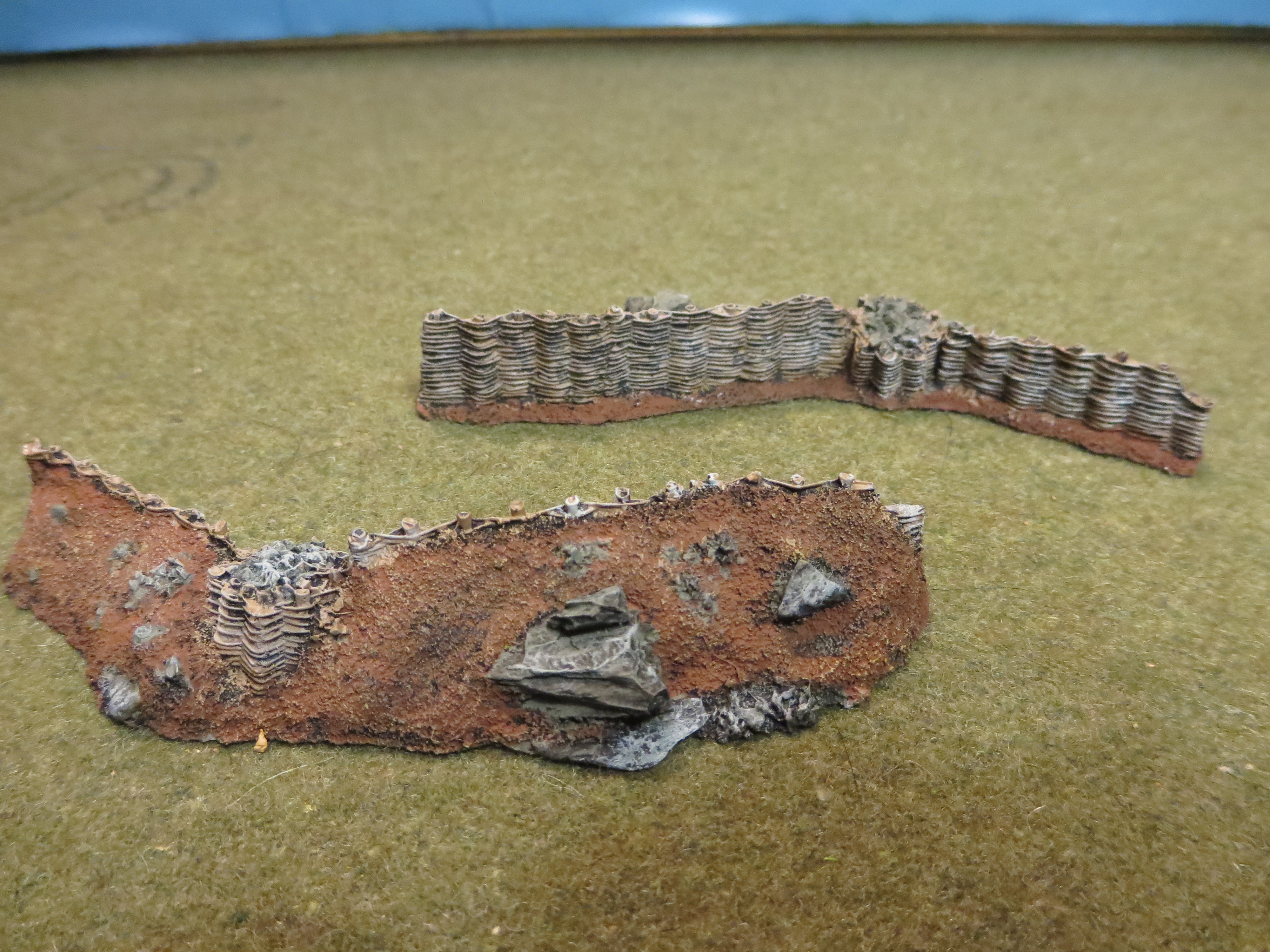
TERRAIN TIME: EARTHWORKS & GABIONS


Old Figures Posing With New Terrain 
Greetings, fellow shut ins!  In this post, we stray into very familiar/unfamiliar territory.  Familiar in that everyone's collection, mine included, contains an array of wargame terrain.  Unfamiliar in that I am definitely in the "buy it painted and assembled" category when it comes to my terrain.  However, I have been wanting a substantial set of earthworks for some time to use with my 28mm Thirty Years War figures. It was not just in 1914-18 that there were extensive lines of earthworks stretching across the landscape. In the wars of the 17th century there were also extensive lines of works laid down to control territory and frontiers.  But I digress.  After coming up dry on finding ready-made versions of these, I finally gave in when I saw the Wicker Earthworks by Daemonscape Terrain offered on ebay (as opposed to the producer's site)...
...and lacking impulse control, I picked up four sets of them. That's 16 pieces, each of 4 inches:  so I now have 64 linear inches of earthworks which I can use in any number of configurations, to include a long line of works stretching across a table. Being my slow self, and not accustomed (okay, even averse) to painting terrain, these took me three weeks to complete.  Below is a study of each of the four pieces found in a set, front and back (clix pix for Big Pix).
I used a black undercoat and did the major parts in acrylic paints (instead of my usual enamels).  The brown for the earth turned out to have a slight red tinge to it, which turned out to be a happy coincidence, giving it a nice "turned up" earth look---which also helped to differentiate it from the browns in the wicker and the dead logs embedded in the earth. I added a few washes of black here and there, and I highlighted the brown with a drybrush of Humbrol Yellow Brown (another very handy color I employ for such uses).
For the wicker, I used another old stand-bye: "Dark Tan" (Testor's Model Master). I brushed the Dark Tan over the high points on the wicker weave, leaving the black to show through in the gaps. I finished it off with a drybrush of white to give it that weathered look--and to help the wicker stand-apart from the brown of the earth. 
The rocks are a dark gray, with a black wash, highlighted with lighter gray and then very lightly drybrushed with white.  I represented the gabions as filled with rocks: gray brushed over the black undercoat, a wash of black, and then drybrushed with lighter gray. 
I'm looking forward to games of my own Smalle Warre system and Pikeman's Lament using these earthworks, which will expand the options and allow for some very interesting scenario and campaign situations. 
Excelsior!

Tuesday, October 27, 2020

POLISH HAIDUKS: OLD GLORY 28MM

 
New Addition : Old Glory Polish Haiduks with Command
 
Greetings, fellow shut ins!  Like many others, my hobbying has been slowed down in the last few months by various and sundry distractions and impositions from the "real world." Nevertheless, connecting with my hobby club-mates in weekly zoom gatherings has provided both motivation and inspiration.  In our case, there has been a renewed interest in Thirty Years War/17th Century topics, with an emphasis on Eastern Renaissance.  This, in turn, brought me to my lead pile to dig out these 28mm Polish Haiduks, which I've had stored away for something like a decade.    This project involved completing two units of 11, with 2 command: 24 figures in all. Given my slow painting pace, this took me just over three weeks to complete.   Given the popularity of the venerable Old Glory line, I was somewhat surprised that I could not track down an example of a painted set of these online somewhere.  So I hope that my project will prove helpful for anyone else embarking on these figures. As usual, you may clix pix for BIG PIX in this study.
 
Red Haiduks
Yellow Haiduks
The new contingent consists of two elements of Haiduks, one with red distinctions and one with yellow. Each has ten musketeers and one "tenth man" file leader. Haiduks were organized in decimals (tens), and the tenth man was often dressed distinctively from his men. My tenth men are in reverse colors.  

 Command and Drummer
As per my norm, I have organized these  into a two unit "company": with the company command consisting of a commander figure and a drummer. 
 
An Unappreciated Figure Line?
These figures come from the Polish Commonwealth set of the Old Glory Eastern Renaissance line. These, along with their English Civil War set, are absolutely splendid figures, meticulously researched, well sculpted, and accurately detailed. As such, they do present a challenge (at least for me) in order to understand what it was that I was painting. For instance, what I initially took as braiding on some of the figures' sleeves (just above the elbow) was in fact the match cord wrapped around the upper arm.  Closer inspection of the hands holding the muskets showed that, in many of them, what I originally thought was a mold line was, instead, the match cord twined between the fingers.  The way that the kaftans and zupans are pinned under the belts on the figures is another detail that warranted research and attention.  
 
Generally speaking, this kind of detail is not usually found in an "old school" figure line. If you have any interest in the era, I highly recommend checking the Old Glory Late Medieval and Renaissance  and English Civil War lines (both of which will provide for Thirty Years War gaming as well). 
 
Excelsior!

Saturday, September 26, 2020

GREAT REBASING DONE & PIKEMAN'S LAMENT FORESHADOWING

Greetings, fellow shut-ins!  Real life has been imposing itself at work and on the personal front, sucking time and energy away from hobbying.  So have faith, dear readers, the pace may have become a bit slower lately, but this blog has not been abandoned.  As I have mentioned before, one of my resolutions has been to mix in a few more "light" posts rather than only posting when I have the time and energy to do something more substantial, which will help with blogging during busy and distracted periods.  This post will fit into that category.  As such, it is mostly a bit of eye candy on the recently completed great basing project (Thirty Years War figs).  As usual, in this post, you may clix pix for BIG PIX.

The new additions lined up: quite an expansion!
Left to Right: New Dragoon, Reiter, and Cuirassier...
...Five New Pike Blocks...
...And Two New Musketeer Platoons (12 Figs Ea).
 
As I've mentioned previously, this collection can be used for a variety of rules sets, to include my own Smalle Warre system.  As such, there are some organizing principles at work that can come into play depending on the system being played.
I've paired my pikes and musketeers into two unit "companies" and included a set of command figures (an officer and musician) for each, color coded to reflect the component units...
...The Red and White Pikes behind their company command.
...The Orange and Green Musketeers behind their company command (you get the idea).
 
Speaking of game systems, I had a near miss with hosting a game a week or so ago. My friend AJ (of AJ's Wargaming Blog) came over and we were going to give Pikeman's Lament a go (one of the systems that these figs would work for).  If you aren't familiar with that system, each side can build a company using points.  AJ wouldn't have the time to send along a list, so rather than me coming up with two companies, I asked another friend of mine, Ralph, who couldn't play, to put together some company lists and send them along to me--I'd have AJ play one of the companies Ralph put together.  In the event, the game did not come off, but it turned out to be a fun exercise to have Ralph put together some lists and me pulling out my toys to see how they would look...
Four Companies for Pikeman's Lament organized by Ralph
Detailed view of each of the Companies.
Plenty of Figures Left Over...
 
The above shot is of the remaining figures in my Thirty Years War/17th century collection after the four companies had been laid out  (well, not quite all of my remaining figures: there are still two more boxes full not pictured). I think it's safe to say that I've got more than enough figures to sponsor a club game-night of Pikeman's Lament or to provide for a group of players in a campaign.  I knew the collection had grown over the years from its rather modest beginnings, but still, it took this exercise gave me a solid confirmation of the size and scope of it: I had never really pulled out all of the boxes and gave them a look, collectively.  It also provided me a an excuse to pull out this particular set of toys and enjoy the spectacle. 
Excelsior!

Tuesday, July 21, 2020

OF ALL BASE PASSIONS, REBASING IS THE MOST MOST ACCURSED


 Pikes in progress: part of the great rebasing project
(Apologies to the Bard, Henry VI, Part I [V. II. 18] for the title of this post)

Greetings fellow shut ins (well, here in the US, many of us are still in shut in mode).  Like many others, one of my aims for this extended lockdown period has been to put a dent in the lead mountain, and also to give the toy-related detritus a good sort and clean out.  I've already completed my first goal, painting up my Romanians, and I've now moved on to the clean out in the form of a major rebasing project that I've been putting off. Specifically, I've accumulated a goodly number of painted 28mm Thirty Years War figures via ebay and other sources over the last few years.  Time to do what I've been avoiding: rebasing them. For those who really have time on their hands, you can check out my related post on basing figures. Moving on to the here and now, in this post, as usual, you may clix pix for BIG PIX.
For starters, I began with this unit of dragoons, which is double the fun because there is a dismounted figure for each mounted one.  The cavalry bases are 1" x 2" and the infantry bases are 1" circulars.  In the days when I first started this collection, I hand painted numbers on all of the pegs, and so for consistency still do so today.  This has given me a great appreciation for the calligrapher's art (which I stink at).  Nevertheless, I assauge myself by imagining that what my crude numerical renditions lack in style is made up for in their rustic charm (that's my story and I'm sticking with it!).  I should add that this marking and basing scheme is intended to allow me to use these figures for a variety of systems. Let me digress for a moment to explain those prior to moving on....
This basing scheme will fit into my Smalle Warre 17th Century skirmish system, which employs units of 10 to 12 individually mounted figures, identified by  color coded pegs on the back (and upon reviewing my page for this system, I see that I need to add a few lines of clarification  to the rules). A game report on this system can be found on this blog for the curious. These same basing conventions and figure counts will allow me to also use this collection for a number of  "company level" systems such as the Pikeman's LamentIrregular Wars, Terra Incognita, and the Perfect Captain's ECW and Spanish Fury Actions systems.
I can also use these figures at the man-to-man level, with each figure having individual statistics (wounds, etc, etc).  I have run multiple games  using a home grown rules system for this level, but have yet to publish it on this blog (the next project!). 
 Next up are the pikes: five units of 12 each (not counting command figures)
Given that in my system pikes would be more limited than musketeers and other foot and have to be deployed in  geometric formations, I decided to mount these both more closely than 1" per figure and on multi-figure stands. So I mounted these 12 figure units on  2, four figure stands (each 1" x 2") and 1, 2 figure stand (1"x 1").  
This configuration gives me the flexibility to show a 2-rank configuration without having an odd stand of four in the back (if all were on 4 figure bases), as  well as facilitating the more standard 3-rank configuration. In addition, it allows for "making change" should a full stand of 4 loses 2 figures.
I also have command figures for each unit (should I need them).  These are on 1" x 1" squares.  
Given that the pikes won't be employed as individuals, I'll dispense with the numbers and pegs and instead just have a colored square on the back (eventually).  In addition, each unit has a unifying "highlight" color (the Orange pike to the right and the Yellow to the left).  In connection with adding the highlight color, any rebasing project I go into also tends to include some level of repainting in order add these kinds of touches and to make the figs consistent with the collection in general (yes: when I pay for painted figures, I almost always wind up repainting them--some more than others--too; makes no sense and makes perfect sense all at the same time).  Next up will be applying the wood filler to each base (the most time consuming bit) and then the marking and flocking operation. When I'm done with this batch of 80+ figures, it will be on to the next ones in the queue...
 ...a unit of reiters and a unit of musketeers...
 ...another unit of musketeers...
 ...a unit of cuirassiers plus a contingent of Petardiers and Engineers...
 ...and a parcel of Scots (musketeers, pikes, cannoneers, and leaders).

Lets' see if I can complete this project before they come out with a COVID 19 vaccine!
Excelsior!
Related Posts Plugin for WordPress, Blogger...