Showing posts sorted by relevance for query freikorps. Sort by date Show all posts

Sunday, April 7, 2019

Freiwilliger Hussars, Jagers, und Hungarian Infantry: Oh My! (Work In Progress)

One Work In Progress--Four Works In Progress?

With a high profile project coming to a head at work this week, I thought I'd blog a bit now while I have the mental space and physical time to do so.  This is a work in progress post, but it is work such as I have never done before: four different units concurrently. Not only are there four unique uniforms and figure sets, but there is a mounted unit mixed in with infantry.  Normally, I would stick to one figure type or style at a time, and certainly would never do infantry and cavalry together. But for some reason--perhaps its spring fever--I am feeling impatient with the normal pace of painting, etc.  A rational part of me knows that doing these together is no shortcut(x number of figures to paint = x amount of time and effort, regardless), but this way I at least avoid the mental setback of starting over x4.  There is only one start point and all are progressing together.  I'm also eager to get this whole batch off the assembly line since these will be useful for both my Hungarians and Austrians--and there are some unique units here, too.  I definitely want to shift to gaming more vs painting as the year goes on. This batch will be a boost towards getting there. As usual, you may clix pix for Big Pix in this report. Here's what's in the pipeline:

Hungarian/Austrian Freiwilliger Hussars
This cavalry unit was inspired by the above images (left from the Knotel  site and the above right from the NY Public Library Vikhuijsen Collection).  Love the jaunty headgear.  I picked the color scheme of the dark green with red trousers.  These fellows will be able to serve with either my Hungarians or with my Austrians:
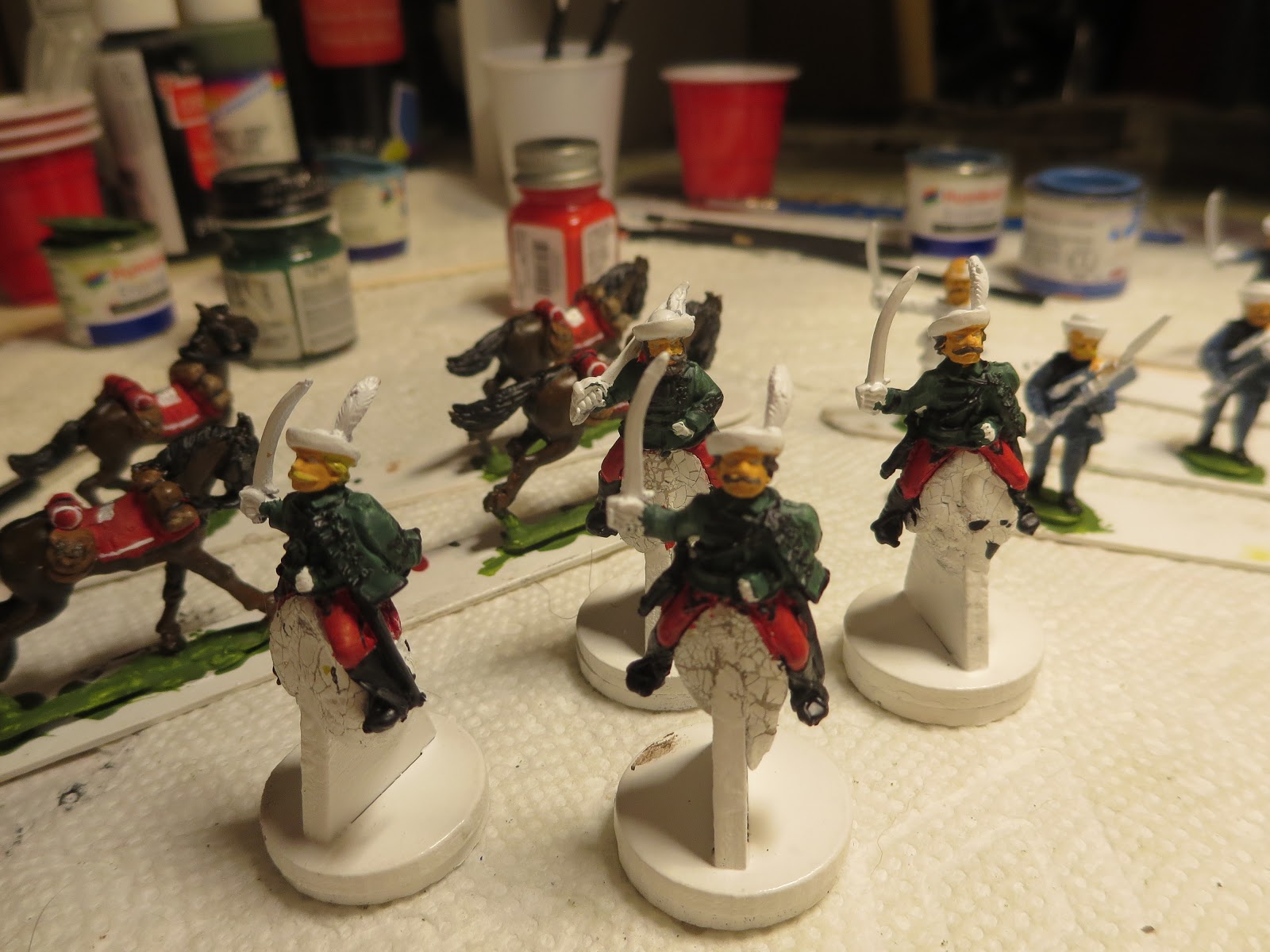
I'm using Foundry Maximillian Adventure Austrian Red Hussars for them. This unit was actually a unit of Austrian Freiwilliger Hussars (so the uniform is essentially appropriate).
These are spiffing sculpts, but I did have to cut off the left half of the blanket roll to make room for the hanging pelisse in order to seat the figures (for the troopers: the officer, since he has no pelisse, sits just fine). I probably could have rummaged about my spares box and come up with three horses, but I liked the mounts that came with these and wanted to give them a go. I think they'll be just fine. 

Hungarian (etc) Freiwilliger Jager/Freikorps
Inspired by these jaunty fellows above (again images from the NYPL collection), I decided to include a unit of Freikorps infantry--these could be fielded with either my Hungarians or Austrians.
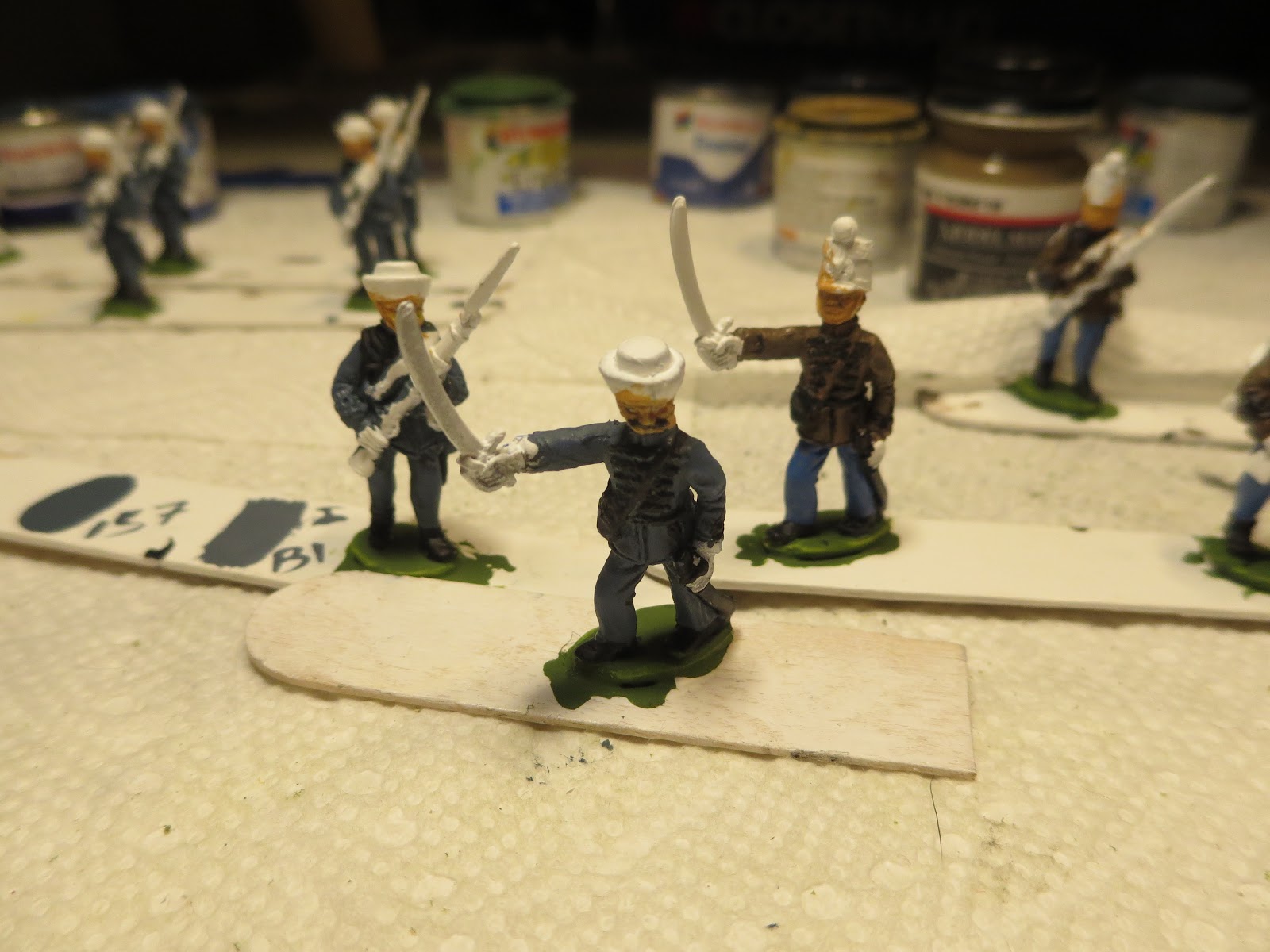
The headgear's the thing for these units, and the Steve Barber Honved Infantry in Porge Kalap fits the bill.  There were various units and variations on this uniform, but I am aiming for the mid blue with black distinctions as seen in the prints. You'd never guess by the photo that these figures have two shades of blue (Humbrol Azure blue base with Humbrol World War I blue dry brushed over).  But the effect, nevertheless, renders a good result (so far).  
Of course, there is a conversion involved!  You knew there had to be.  To get a Freiwilliger officer (above left), I did a head swap (above right) using the torso of a Steve Barber Honved/Hungarian Officer and the head of one of the infantry in porge kalap.  So far, so good. 

Imperial Regular Infantry In Hungarian/Honved Service
During the Hungarian Revolt, many of the Hungarian Infantry units of the Regular Imperial Army fought on the Hungarian side.  They continued to wear their Imperial uniforms (except for black strapping and Hungarian cockade). So, I thought it would be good to have some white coated fellows among my Hungarians. It's taken some effort to keep all the black strapping from looking like a solid "cuirass" across the chest.  The single white strap of the bread bag looping over from the right shoulder to left hip has proven to be a saving grace in breaking up the black. I'll continue to pay particular attention to this area as these figures progress.  These are Steve Barber Szekely Infantry Advancing; they will serve equally well as Imperial infantry in Hungarian service.  
Honved Infantry in Standard Brown Attila
Although it would be quite appropriate for the Hungarian/Honved infantry to be quite varied and colorful, I thought it still would be good to have another "standard" brown-coated infantry in shako in my core Hungarian/Honved infantry contingent.  The new twist is the officer in shako (that is a new release: all my previous have been in slant caps).   

Still lots of painting and then plenty of touching up to go before these are presentable. I expect that I'll be spending a quiet hour or so per night on these for this week.  I hope to have this project (four projects?) wrapped up in time for my next post (or the one after that, if not).
Excelsior!

Saturday, May 31, 2025

CONVERSIONS FOR ONE HOUR SKIRMISH: FREIWILLIGER JAGERS & GRENZER NCO


Newly added contingent to my One Hour Skirmish  collection: Freiwilliger Jagers. It may come as no surprise to regular readers to this blog to hear that these are conversions.


Although they are not intended to represent any specific element, they are intended to represent any of the various volunteer and constabulary elements that were either raised to supplement forces during the continental conflicts of the era or that performed security/paramilitary operations in any number of frontier regions across Europe, particularly in the Hapbsburg dominions in the Balkans--and similar forces found under various flags across Southern & Eastern Europe. The above images from the New York Public Library Vikhuijzen Collection of Austrian Freiwilliger Jagers from the Temesvar Region provided the general model for these. Of course, nobody actually makes these figures (not quite, anyway)...
...but the Honved Infantry in Porge Kalap from the Keelman Miniatures Hungarian Revolt Line comes very close...
...and so, all that was needed to make them fit was to add the feather plume to the headgear.  I did so with a two step process. First I clipped small bits of lead foil to represent the feathers, then adhered them to the caps using dabs of J&B Kwik Weld (fast drying version). After that had set, I added more J & B Kwik Weld to the standing part of the lead foil to reinforce it against the handling that the figures would inevitably receive.  For those who are really curious, you can look at my April 7, 2019  post where I detail the same process for a set of unit-based figures.  Below, you can see the outcome of this latest project  (clix pix for BIG PIX)...

...the simple addition of the plume really transforms these figures (in my opinion) and was worth the effort.  In doing these, I aimed for the distinctive blue/gray color of the source images along with the black cording. It's not evident, but there are two shades of blue on these figures (an undercoat of Humbrol Azure Blue with a drybrush of Humbrol WWI blue, highlighted with a slight drybrush of light gray).  I went with black strapping given that this was a distinguishing feature of jagers and various and sundry volunteer/freikorps of the era. So far, we have accounted for the private soldiers, but what about the leaders?
For an officer, I used a Honved officer in shako (above right) from the aforementioned Keelman Miniatures Hungarian Revolt Line and a head swap from the Honved infantry in Porge Kalap (above left)...
The newly completed individually mounted converted officer (left) next to an earlier completed source figure (right) mounted on a unit base.
Detail of the completed conversion officer figure.

One Hour Skirmish is a very low level system, with small figure counts more akin to squad actions than platoons or higher. As such, officer figures can certainly be involved, but the more prevalent  "leader" figures at this level would be NCOs: soldier-leaders carrying rifles. Unfortunately, most leader figures (in pre-2oth Century lines, where I am focused) are of officers. So, to provide NCOS...  

...I used an actual era-specific NCO figure, a Keelman Miniatures German Legion NCO (above right) from the Hungarian Revolt line, with another head swap from a Honved Infantry in Porge Kalap...
...the resulting side-by-side comparison of the completed conversion (right) next to a completed source figure.


Detail of the NCO conversion.  I gave him yellow trim on his headgear as opposed to the officer's metallic gold, and his sleeve decorations (hungarian knots) are a bit more elaborate than those of the private soldiers (added using my "Home made Hungarian Knots" process). 

Especially attentive readers may have noted that the above German Legion NCO figure is not painted in accordance with the black-on-black scheme of that force (per the image of the German Legion taken from my October 2016 Post). 


I instead did this figure in an all-purpose scheme of brown jacket and blue trousers...

...one that will allow me to field him as a leader of Grenzers or any similar force in the era.

Excelsior!

Monday, May 27, 2024

CHOCOLATE BOX WARS WORK IN PROGRESS: ERSATZ SOLDATEN


Print and Play Bavarian-Themed Ersatz Soldaten for Chocolate Box Wars (or any system, really).  Two battalions of line infantry flanking an artillery battery,  a half battalion of freikorps out front, and command behind the line. (The camera picks up the protective fixative for some reason, making them look washed out or as if there is a film on them, which is not visible in person.) 

For long term followers of this blog, you may recall the running start I made on my 19th Century game system, Chocolate Box Wars, the details of which you may find at the linked resource page on this blog.  In short, this is intended to be a "battle in a box" system to play post-Napoleonic continental (mainly) wars. Unfortunately, life got in the way and the project got sidelined (although I did produce my interim Volley and Bayonet variant for the era, which has worked out quite well, but that's another story).  And, of course, I've produced multiple mid-century armies to play this era (Russians, Austrians, Hungarians, Danes, Prussians, Romanians...I think that's all of them). Back to CBW. I have picked up the project again completing the first draft of the rules and moving on to playtesting (more on this, anon).  The problem is, though, that my collections are still packed up and in storage. Thus, I needed an interim solution to get them on the table for playtesting, which brings me to this post (talk about burying the lede!). Although I have minis--that's for sure--I certainly am not averse to other forms of representation (see my Half Scale Kriegspiel Block treatment for Bloody Big Battles), and so I produced what I am calling my Ersatz Soldaten: print and play CBW armies.  I'll share them with you here. As usual, in this post, you may clix pix for BIG PIX...

I went to a variety of online public sources, like the New York Public Library, and a considerable library of digital images that I had downloaded over the years, and pulled likely images that would work together to represent armies. I then resized them, touched them up, and put them on backgrounds to make them consistent. In real terms, these are roughly 1.25" by 1.75".  Not being a fan of the usual overhead view of print and play printed miniatures, I much prefer these representations. 
Long ago, I produced a boatload of sabots (above left). These are 2.25" x 2.25" plywood stands with metal wargames stands glued to them (painted a handsome green).  They are very close to the size of the stands for the CBW system, so they will work nicely for playtesting. All of my figures have magnetized bases, so the original idea was that I could put my individually-mounted figures on them if I ever wanted repurpose them to play a "rank and flank" system. They also have come in handy for other uses (as you'll see).  I also produced a set of labels on magnetic sheets for my CBW units (above right). These will (when the time comes) be useable on the metal strips on the back of my miniatures stands (a standard feature of my basing schemes). In the meantime, they will work on the sabots as well. 
I printed the army sheets, put them on sheet magnet, and cut out the individual soldiers, producing six armies. They are shown stored here, all in one handy little container. All I need to do is pull them out and put them on the sabots. Not being rigorous representations, they are "themed": British, Prussian, Bavarian, Belgic, Nordic, and French.  All will work for Ruritanians, of course!  All I need to do is put them on the sabots with labels and I'm off to the races. 

By example, here are the four pages of the Bavarian Themed print and play army. Of course, I can print out more if I want more of any type of unit.

Here is a graphic representation of the British Themed army showing the size and configuration of a CBW army. As mentioned, the figure count is not high, consisting of a core force (four line infantry, one cavalry unit, one battery, and a command) plus supplemental units chosen from each of the three categories. When I publish the rules, this will (hopefully) make more sense. But for now, I think this gives a good idea of the look of the game using the Ersatz Soldaten. 
Getting back to "figures" on table, above left are a few French themed units with labels and my newly produced 1 pfennig activation markers (face down). Above right, a face down activation marker and face up  activation marker (eagle showing). The camera did not pick it up, but the face up eagle is much brighter than the "1" face-down (which still has the patina). We proofed this system in our first playtest and the distinction between the two was quite clear during use (unlike in the photo!).  This was good news given the amount of effort that had gone into them!
To round out the look of the Ersatz game, I wanted the table to look "graphic" like the units. So rather than pulling my 3D terrain out of storage, I pulled images from my period Kriegpsiel maps to make forest and town templates, mounting them on cardstock, and am using mat board step hills (I may tart these up a bit in future).  For trees, I picked up the delightful 2D trees from Wofun's Tabletop Terrain. 
I have since added a toy soldier-like base to the trees. The overall look of the table is pretty close to what I was aiming for. So much so that what began as an interim has now moved up to an alternate. I will continue to use these even after my miniatures come out of storage, particularly to playtest a scenario or when I want to get a game on the table in short order. And the Ersatz Soldaten will certainly be useable for other system: I'm thinking that they would work nicely in any hybrid miniatures and/or gridded miniatures system like Bob Cordery's Portable Wargame for instance. 

The French Themed army ready to be deployed at the start of the Battle of the US Army Blanket, the first playtest of the CBW system: a modest report on which will be forthcoming. 

As a reward for reading this far, here are links to download (or just review) the CBW armies in pdf (you're on your own for terrain); enjoy! 

Once the system is proofed and finished, I'll add a stand alone resource page to this blog and post the rules there (along with these Ersatz Armies). 

Excelsior!

Related Posts Plugin for WordPress, Blogger...